






Fears of an impending Nvidia AI bubble are dissipating rapidly as the tech giant’s latest financial results shatter expectations. Nvidia reported a staggering 62% year-over-year sales increase, firmly establishing its dominance in the AI chip market. With revenue reaching $57 billion in the third quarter, the company has not merely met but significantly exceeded Wall Street’s projections.
Despite ongoing concerns about the cooling effects of the Nvidia AI bubble on the broader tech market, CEO Jensen Huang has boldly projected $500 billion in AI chip sales for 2025 and 2026. The company’s data centre segment has been particularly impressive, generating $51.2 billion in revenue, well above the anticipated $49 billion. Furthermore, Nvidia’s fourth-quarter projections of approximately $65 billion in revenue have further weakened the Bloomberg narrative of an Nvidia AI bubble. However, the risks associated with Nvidia AI bubble valuation remain a topic of debate among some analysts. This remarkable performance comes at a critical moment when investors have been questioning the sustainability of AI-driven growth across the tech sector.
Nvidia Reports a 400% Profit Surge in Q3
Nvidia’s financial dominance reached new heights as the tech giant posted an astonishing 400% year-over-year profit growth in its third fiscal quarter of 2025. The company’s stunning performance has silenced critics concerned about a potential Nvidia AI bubble, as concrete financial results continue to outpace even the most optimistic projections.
Revenue Hits $57 billion, Beating Wall Street Estimates
Nvidia reported record quarterly sales of $53.67 billion, a staggering 94% increase over the same period last year and a 17% increase over the prior quarter. This impressive figure easily surpassed analysts’ expectations of $83.97 billion. The company’s GAAP earnings per share reached $1.99, exceeding Wall Street’s projected $1.91. Moreover, Nvidia’s outlook remains exceptionally strong, with fourth-quarter revenue forecast at approximately $99.38 billion, significantly above the $94.28 billion anticipated by market analysts.
Data Centre Sales Drive the Majority of Growth
At the core of Nvidia’s extraordinary performance lies its data centre segment, which generated a record $47.09 billion in the third quarter—representing a 17% increase from the previous quarter and an astounding 112% growth year-over-year. This division now accounts for nearly 90% of the company’s total revenue. Specifically, compute products contributed $65.75 billion while networking components added $12.54 billion to data centre sales. CEO Jensen Huang noted during the earnings call that “Blackwell sales are off the charts, and cloud GPUs are sold out”, indicating the intense demand driving this segment’s expansion.
Stock Jumps 5% in After-Hours Trading
Following the announcement of these exceptional results, Nvidia’s stock price surged approximately 5% in after-hours trading. This market response effectively countered the Bloomberg Nvidia AI bubble narrative that had gained traction in recent weeks. As Angelo Zino from CFRA told Yahoo Finance, “The company is essentially completely being driven by data centres”, adding that supply constraints will likely persist through 2026 and potentially into 2027, suggesting continued strong performance ahead. Additionally, CFO Colette Kress revealed during the earnings call that Nvidia “currently has visibility to a half a trillion dollars in Blackwell and Rubin revenue from the start of this year through the end of calendar year 2026”, further alleviating Nvidia AI bubble cooling concerns among investors.
Related Article: Nvidia Blackwell Chips Restricted to US Markets Amid Global Tech Race
CEO Jensen Huang Dismisses AI Bubble Concerns
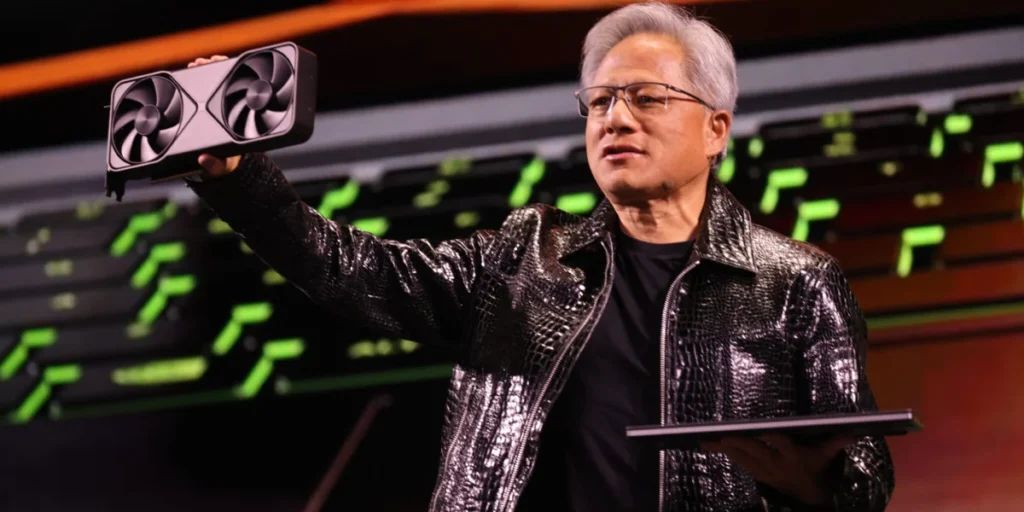
In stark contrast to growing market speculation, Nvidia’s Chief Executive Officer, Jensen Huang, has directly challenged the notion of an AI bubble. “There’s been a lot of talk about an AI bubble. From our vantage point, we see something very different,” Huang declared during Wednesday’s earnings call with analysts.
Huang: ‘We’ve entered the virtuous cycle of AI’
According to Huang, the technology sector has achieved what he terms a “virtuous cycle” of AI development. “The AIs get better. More people use it. More people use it, it makes more profit, creates more factories, which allows us to create even better AIs,” he explained at the APEC CEO Summit in South Korea. This self-reinforcing loop is driving what Huang describes as the first fundamental change to computing in six decades, with “every single layer of the computing stack being changed”.
Nvidia’s Chips Power Every Phase of AI Development
Huang outlined a three-pronged argument against bubble fears, noting Nvidia is uniquely positioned to address all three phases of AI evolution. First, traditional computing systems are transitioning to GPU-based infrastructure. Second, entirely new AI applications are emerging. Ultimately, “agentic AI” will enable autonomous systems that require even more computing power. “We’re in every cloud. The reason why developers love us is because we’re literally everywhere,” Huang emphasised. Indeed, he reiterated a forecast of AUD 764.50 billion in bookings for advanced chips through 2026.
Analysts Echo Confidence in Long-Term AI Demand
Nevertheless, not all analysts have been convinced by Huang’s dismissal of Nvidia AI bubble concerns. Stifel analyst Ruben Roy noted, “The concern that AI infrastructure spending growth is not sustainable is not likely to ebb”. Likewise, Kinngai Chan from Summit Insights cautioned investors would “remain concerned about the sustainability of its customers’ capex spending increase and the circular financing in the AI space”. Yet Dan Ives from Wedbush Securities described Nvidia as “the foundation of the AI Revolution,” reinforcing the company’s central position in what many believe is just the beginning of a decade-long industry transformation.
Markets Rally as Nvidia Deflates AI Valuation Fears

Stock markets worldwide staged a dramatic recovery immediately after Nvidia’s blockbuster earnings report, with relief spreading across trading floors. The tech giant’s exceptional performance effectively countered fears of an overvalued Nvidia AI bubble that had dominated market sentiment in recent weeks.
Global Indices Rise Following Earnings Report
European bourses recorded substantial gains across the board, with Germany’s DAX rising 241 points (1%), France’s CAC climbing 90 points (1.1%), and the UK’s FTSE 100 adding 72 points (0.77%). In the United States, futures pointed sharply higher, with the tech-heavy Nasdaq 100 leading the charge, up 1.6%, alongside S&P 500 futures, which rose 1.2%. Meanwhile, Asian-Pacific markets also rallied as investor confidence returned.
Investor Sentiment Rebounds after Recent Tech Slump
Prior to Nvidia’s announcement, global equities had tumbled amid growing concerns about inflated valuations. Subsequently, Nvidia’s performance triggered a ripple effect throughout the technology sector. Shares of Advanced Micro Devices, Broadcom, Micron Technology, Super Micro Computer, and Arm all posted solid gains in after-hours trading. As Jim Reid from Deutsche Bank noted, “Nvidia’s results have completely changed the market mood and pushed out any bubble fears for another day”.
Bloomberg: Nvidia AI Bubble Cooling Narrative Weakens
The Bloomberg Nvidia AI bubble theory, which had gained traction, now faces significant challenges. Thomas Monteiro, senior analyst at Investing.com, summarised the situation: “This answers a lot of questions about the state of the AI revolution, and the verdict is simple: it is nowhere near its peak”. In fact, many analysts now view the recent market pullback as “a healthy correction” rather than the beginning of a sustained downturn. Certainly, Nvidia AI bubble cooling concerns have been temporarily silenced by concrete financial evidence of continued growth.
Analysts Weigh Risks of Customer Concentration and Circular Deals

Amidst the jubilation surrounding Nvidia’s record performance, analysts are increasingly scrutinising potential vulnerabilities in the company’s business model that could threaten the stability of the Nvidia AI bubble.
61% of Revenue Tied to Four Major Customers
Nvidia’s regulatory filings reveal a worrying concentration risk, with four unnamed customers now accounting for 61% of its total sales, up from 56% in the previous quarter. Past announcements suggest that these could include tech giants such as Microsoft, Meta, and Oracle. This concentration has steadily increased, with two anonymous customers alone comprising 39% of revenue earlier in 2025.
Concerns Over Circular Investments with Microsoft and Anthropic
Simultaneously, scrutiny intensifies around what critics call “murky circular deals” within the AI industry. A notable example is the recent partnership between Microsoft and Nvidia, where the two companies jointly invested up to AUD 22.93 billion in AI startup Anthropic. Consequently, Anthropic committed to purchasing AUD 45.87 billion in Azure compute capacity running on Nvidia chips.
Experts Debate the Sustainability of AI-driven Growth
Given these arrangements, analysts remain divided on long-term prospects. “The concern that AI infrastructure spending growth is not sustainable is not likely to ebb,” warns Stifel analyst Ruben Roy. Chaim Siegel of Elazar Advisors expresses even greater scepticism: “A lot of this growth is coming from loss-making startups or loss-making projects, so most likely the cycle ends badly”. Conversely, others highlight that major customers have “bountiful cash on hand”, potentially mitigating immediate Nvidia AI bubble valuation risks.
Conclusion – Nvidia AI Bubble
Nvidia’s extraordinary financial performance undoubtedly challenges prevailing narratives about an AI bubble. Their 400% profit surge, alongside $57 billion in revenue, demonstrates substantial market demand rather than speculative enthusiasm. Additionally, the company’s data centre segment continues to serve as the primary engine of growth, accounting for nearly 90% of total revenue.
Jensen Huang’s confident assertions regarding the “virtuous cycle” of AI development appear justified by concrete financial results rather than mere optimism. Nevertheless, legitimate questions remain about customer concentration risks, as four clients now account for 61% of Nvidia’s revenue. Similarly, the complex web of investments between major tech players raises questions about the sustainability of current growth trajectories.
Market reaction tells a compelling story as well. The immediate global rally following Nvidia’s earnings announcement suggests that investors have temporarily set aside concerns about a bubble in favour of tangible performance metrics. Though some analysts still express reservations about long-term sustainability, especially regarding startups with negative cash flow, others point to the substantial financial resources of Nvidia’s major customers as a stabilising factor.
The remarkable quarterly results certainly provide strong evidence against fears of an imminent bubble. However, prudent observers will continue monitoring both the expanding applications of AI technology and potential structural vulnerabilities in the ecosystem. Regardless of differing perspectives on future valuations, Nvidia has effectively demonstrated that current AI demand remains robust, genuine, and financially rewarding—at least for now.
You May Aslo Be Interested In: Nvidia Market Cap Hits Historic £5 Trillion, Joins Elite Tech Club
What were Nvidia’s key financial achievements in their recent earnings report?
Nvidia reported a 400% year-over-year profit surge, with revenue reaching $57 billion in the third quarter. The company’s data centre segment generated $51.2 billion in revenue, significantly exceeding Wall Street estimates.
How has Nvidia’s performance impacted concerns about an AI bubble?
Nvidia’s exceptional financial results have largely deflated fears of an AI bubble. The company’s concrete growth figures and strong market demand have weakened the narrative of an overvalued AI sector, at least in the short term.
What is Jensen Huang’s perspective on the current state of AI development?
Nvidia’s CEO, Jensen Huang, believes we’ve entered a “virtuous cycle of AI” where improvements in AI technology lead to increased usage, profits, and further advancements. He dismisses bubble concerns, viewing the current situation as a fundamental shift in the computing landscape.
How have global markets responded to Nvidia’s earnings report?
Following Nvidia’s earnings announcement, global stock markets rallied significantly. Major indices in Europe and the US saw substantial gains, with tech stocks leading the charge. This positive reaction indicates renewed investor confidence in the AI sector.